Fast facts
- Division: Heavyweight (former undisputed UFC Heavyweight Champion)
- Record: 106-5 over four years of college wrestling. His final UFC win, over Mark Hunt at UFC 200, was overturned to a no-contest.
- Nationality: American (born in Webster, South Dakota)
- Team/gym: University of Minnesota wrestling (college)
- Notable wins: Shane Carwin (unified the UFC heavyweight titles, 2010). Also the 2000 NCAA Division I heavyweight championship.
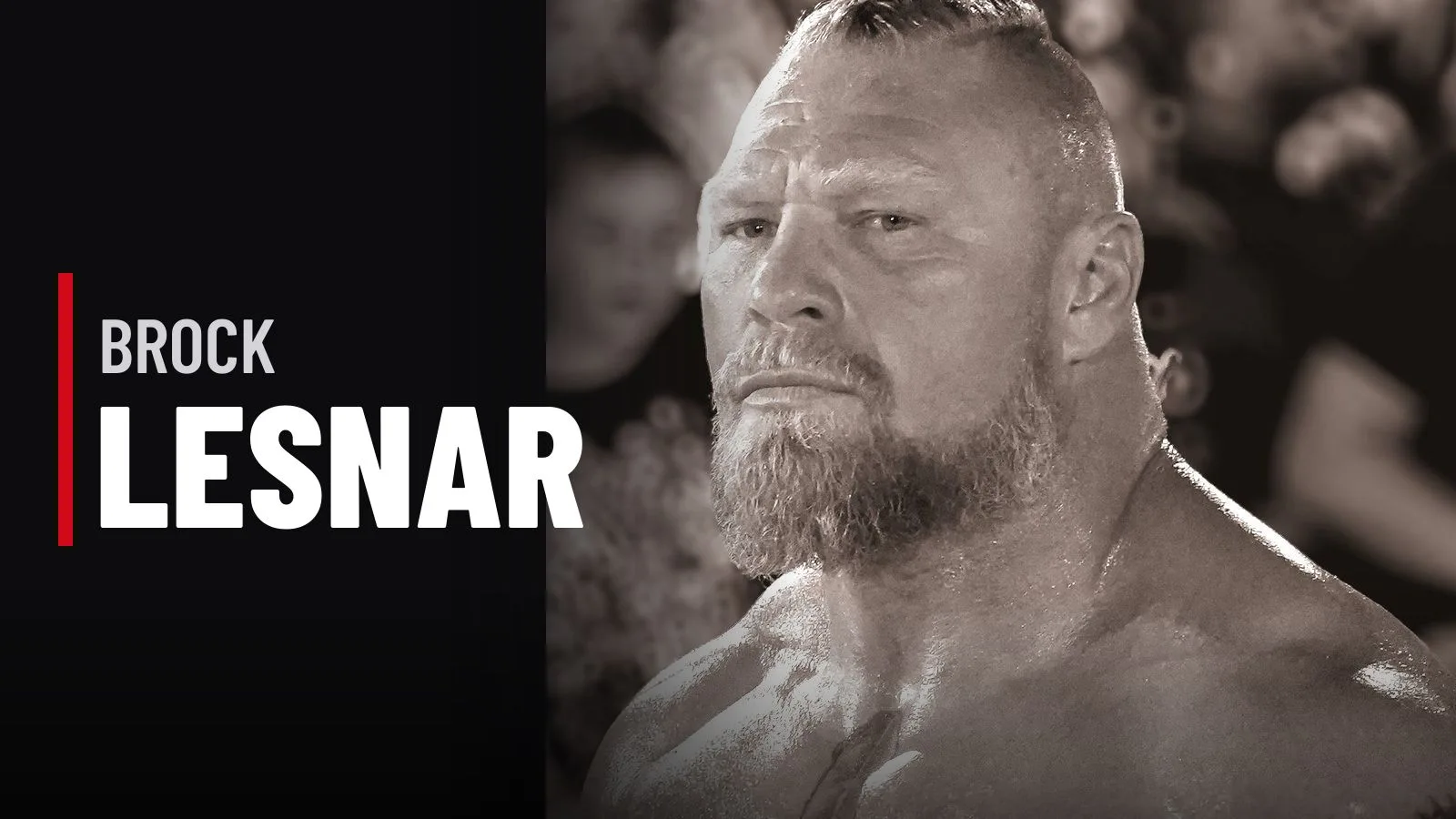
At 17, Brock Lesnar joined the Army National Guard with a plan to work with explosives. The plan lasted until somebody noticed he was red-green colorblind, which the Guard decided was a bad trait for a man handling things that blow up. They put him at a desk instead. Then he failed a computer typing test and was discharged, and he went to work for a construction company.
It’s a small, slightly absurd story, and I keep coming back to it because it tells you what the rest of his life would be built on. The keyboard beat him. Almost nothing physical ever did, at least not for long.
He grew up on his parents’ dairy farm in Webster, South Dakota, born July 12, 1977, to Stephanie and Richard Lesnar. He had two older brothers, Troy and Chad, and a younger sister, Brandi. The surname is Slovenian, but the family is of Polish descent. If you want an origin story for a heavyweight, a dairy farm with two older brothers is about as honest a starting point as you’ll find.
The wrestling room
Lesnar played football and wrestled at Webster High School and placed third at the state championships as a senior. Third. He wasn’t a prodigy anointed at 15, and nobody was printing his name in a recruiting magazine.
So he went the junior college route, which is where a lot of good wrestlers go when the big programs aren’t calling. At Bismarck State College he placed fifth at 275 pounds in the NJCAA as a freshman in 1997. A year later he won the 275-pound national title.
That got him a wrestling scholarship to the University of Minnesota, and here’s a detail I love. His roommate there was Shelton Benjamin, who was also his assistant coach. Think about that arrangement for a second: the guy correcting your stance in practice is the same guy you’re splitting a dorm with. Benjamin would later become a WWE colleague, too, but in Minneapolis he was part of the machinery that turned a third-place state finisher into something else.
In 1999 Lesnar made the NCAA Division I heavyweight final and lost to Stephen Neal. He came back as a senior in 2000 and won it. He left college as a two-time NJCAA All-American, a two-time NCAA All-American and a two-time Big Ten champion, with a 106-5 record across four years. Five losses in four years, starting from a junior college mat in North Dakota.
The detour everyone knows
He signed with the WWF in 2000, spent time in its Ohio Valley Wrestling developmental territory, and met Paul Heyman there. By August 2002 he had beaten The Rock at SummerSlam for the WWE Undisputed Championship, 126 days after his television debut, becoming the youngest WWE champion ever at 25.
He walked away in 2004, later citing burnout, injuries, frustration with creative and the travel schedule. He tried the NFL with the Minnesota Vikings and was cut during the preseason. He went to Japan, won the IWGP Heavyweight Championship in his first New Japan bout at the Tokyo Dome in 2005, and eventually took a break from wrestling entirely to try fighting.
The cage
Lesnar’s MMA career began with Hero’s in 2007. He signed with the UFC in 2008 and won the UFC Heavyweight Championship quickly, which in a division full of veterans felt outrageous at the time. He arrived with almost no fight experience and a national wrestling title, and the wrestling title carried him a long way.
He also sold like nobody else. Lesnar headlined UFC 91, UFC 100, UFC 116 and UFC 121, some of the best-selling pay-per-views the promotion has ever run. Plenty of fighters get called box office. He actually was.
Then his body turned on him. Diverticulitis sidelined him in 2009, and it’s worth sitting with how serious that was for a man whose whole game was strength and size. He came back in 2010 and beat Shane Carwin, the interim champion, to unify the belts and become undisputed champion again. That’s the win on his record I’d point to first. He returned from a real illness to beat a man who held a version of his title.
In October 2010 at UFC 121, Cain Velasquez knocked him out and took the belt. It was Velasquez’s seventh UFC fight. Velasquez was an NCAA Division I All-American at Arizona State, so for once Lesnar was across from a man whose wrestling pedigree could meet his. Alistair Overeem beat him next. After those two losses and more trouble with diverticulitis, Lesnar retired from MMA in 2011.
He came back once, at UFC 200 in 2016, against Mark Hunt. He was briefly the main event before that slot went to Amanda Nunes vs. Miesha Tate, and he won. Then he tested positive for a banned substance under the UFC’s anti-doping policy, and the result was overturned to a no-contest. He retired from MMA a second time in 2017. That’s an unhappy final page, and I don’t think it should be skipped in a profile.
Where he stands now
The pro wrestling side kept going far longer than the fighting. He returned to WWE in 2012, ended The Undertaker’s 21-0 WrestleMania streak in 2014, and had his retirement match in the main event of Night 1 of SummerSlam in 2026. He’s the only person to have held the top heavyweight titles in WWE, the UFC, New Japan, the Inoki Genome Federation and the NCAA.
This week Yahoo Sports ran a piece in which the ex-UFC champion talked about what the M Club Hall of Fame means to him. Elsewhere, in an MMA Mania column about Mike Malott headlining UFC Edmonton, the writer listed Lesnar among the names (next to Georges St-Pierre, Rory MacDonald, Patrick Cote and Sam Stout) that turned him into a fan and eventually a writer. That’s the kind of reach he had in his UFC years, even north of the border.
The two men who beat him in the cage are still busy. Velasquez, 44 and out on parole since earlier this year, has been back at American Kickboxing Academy teaching younger fighters and posted footage on Instagram of himself drilling body lock defense with Alex Pereira ahead of Pereira’s UFC 335 co-main against Sergei Pavlovich on December 12 at T-Mobile Arena. Overeem, as MMA Fighting’s Guilherme Cruz reported, wants to box Rico Verhoeven on the Tyson Fury vs. Anthony Joshua card on December 11 in Cardiff.
Lesnar has no fight booked and no match booked. He’s retired from both worlds now, and the last thing on his calendar was the main event of a SummerSlam night. Not bad for a kid the National Guard sent home over a typing test.